Where to Find Top Smart Watch Band Suppliers in China?
China is a major sourcing base for Smart Watch Bands, with manufacturers and trading companies serving different budgets and product needs. Shenzhen, Dongguan, and other manufacturing centers offer access to materials, production services, and export experience. Still, a supplier’s location alone does not guarantee quality.
For buyers, the challenge is separating capable factories from vendors with limited production control. Details matter. Band material, connector fit, buckle finish, and color consistency can all affect the finished product. A polished product photo is useful, but it cannot replace samples or clear specifications.
This guide explains where to look, how to compare suppliers, and what questions to ask before requesting a quotation. Check whether a company can explain its materials, customization options, sample process, and inspection steps. Ask for recent product samples and confirm that the proposed design fits your target watch models. Written specifications help reduce misunderstandings about dimensions, colors, packaging, and order quantities.
Be cautious of vague answers, unusually low prices, or claims that cannot be supported with documents or samples. Even a careful checklist cannot remove every sourcing risk; independent verification still matters. The right supplier is not always the largest or cheapest. It is one whose capabilities match your requirements and whose communication stays clear when details change.
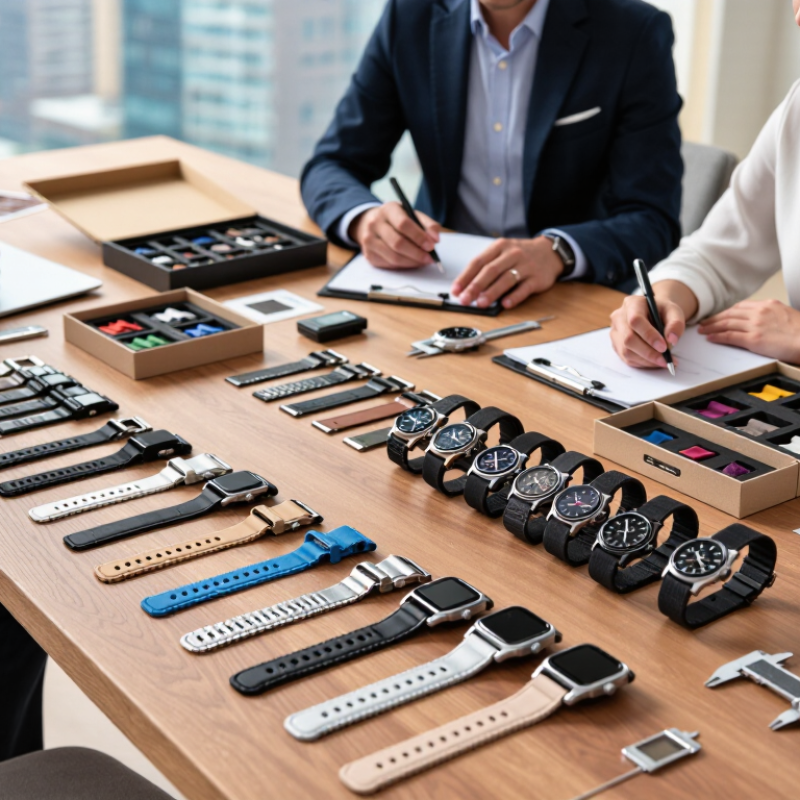
What Defines a Top Smart Watch Band Supplier in China?
A top smart watch band supplier in China proves capability with repeatable production, not polished catalog photos. IDC reported that global wearable-device shipments reached 537.7 million units in 2024, up 6.1% year over year. That scale raises expectations: suppliers should explain material options, tooling limits, and how they control color, clasp fit, and strap dimensions between batches. Ask for dated samples and inspection records. Look closely at pin alignment and the finish inside the strap holes.
Technical depth matters. A capable supplier can discuss silicone hardness, skin-contact material documentation, buckle corrosion checks, and packaging protection without vague promises. Request a documented quality plan, defect criteria, and a clear process for handling failed inspections. Verify production capacity against your forecast, then compare stated lead times with a small pilot order. A perfect sample proves little about a large run. That gap is easy to miss.
Tips: Ask for recent batch photos, test reports, and a sample from normal production. Confirm who performs inspections and whether results are recorded. No checklist removes every risk; I would still recheck the first shipment, especially where clasp tolerances feel slightly inconsistent.
Which Regions in China Produce Smart Watch Bands?
Guangdong is the strongest starting point for smart watch band sourcing. Shenzhen and Dongguan offer nearby plastics, silicone molding, metal finishing, packaging, and electronics services. This density can shorten sample revisions. IDC’s Worldwide Quarterly Wearable Device Tracker reported 506.7 million global wearable-device shipments in 2023, showing the scale of the broader market. However, that figure covers many device types, not bands alone.
Zhejiang is another useful region. Yiwu’s small-commodity network supports varied colors, materials, and low-volume accessory orders; Ningbo adds established plastics and manufacturing suppliers. Ask factories for material specifications, color tolerances, and production samples. Details matter. Public industry statistics rarely separate smart watch bands from other accessories, so regional rankings should be treated as practical sourcing guidance, not audited production totals.
Jiangsu can suit buyers seeking precision components and more controlled manufacturing processes, particularly around Suzhou and Kunshan. Its suppliers may be better suited to metal links, buckles, or molded parts than to complete band programs. That distinction is easy to miss. Before choosing a region, compare the supplier’s own production records, quality-control steps, and sample consistency; location alone proves little.
What Types of Smart Watch Bands Do Suppliers Offer?
Smart watch band suppliers in China commonly offer silicone, TPU, woven nylon, leather, and metal bands. Silicone and TPU feel light and flexible, making them practical for daily wear and workouts. Woven nylon has a softer, textured surface, while leather gives a more formal look. Metal options often include mesh or linked designs. Each material has trade-offs. For example, pale silicone may show stains, and some metal bands feel heavy after several hours.
Suppliers may also provide hybrid styles, combining materials such as a metal clasp with a woven strap. Options can include different widths, colors, buckle types, and printed or embossed details.
Before placing a large order, request samples and check the finish, stitching, clasp movement, and fit against the intended watch case. Ask how the supplier controls material consistency between batches. A sample can look excellent, yet production may vary; that risk is worth discussing plainly.
I would not choose by appearance alone. Comfort is easy to overlook until someone wears the band all day.
How to Verify a Supplier Before Placing an Order
Before ordering smart watch bands, verify the supplier’s actual production capacity. Ask for a live video tour of the cutting, stitching, molding, and packing areas. Match the business license name with the quotation, invoice, and bank account. Request recent audit records, material specifications, and test reports for the exact band model. A polished sample is not enough.
Market data makes careful checks worthwhile. Counterpoint Research reported that global smartwatch shipments fell 1% in 2023, the first annual decline recorded in its tracker. IDC, meanwhile, reported that worldwide wearable-device shipments grew 1.7% to 519.2 million units that year. These figures cover different product categories, but they show why demand forecasts can be uncertain. Ask suppliers how they handle small trial orders and changes in production schedules.
Test samples with real use in mind. Check buckle closure, hole spacing, edge finish, and skin-contact comfort after repeated bending. Confirm color, dimensions, packaging, and defect limits in writing before production. For bulk orders, agree on inspection timing and a clear process for rejected goods. Keep dated photos and signed sample records. No checklist catches every weak batch. I would still review the first production lot closely; that step is easy to underestimate.