Top 10 LED Power Supply Manufacturers Worldwide
Choosing among the Top 10 LED Power Supply Manufacturers Worldwide requires more than comparing prices or wattage. A driver may look similar on a specification sheet, yet behave differently under heat, voltage fluctuation, or years of daily use. Look closely at efficiency, dimming compatibility, protection features, certifications, warranty terms, and service support. Small details matter. A loose connector or poor thermal design can affect the whole lighting system.
Solid-state-lighting researcher Dr. Nadarajah Narendran provides a useful technical perspective. The following line is an editorial paraphrase, not a verified direct quotation: “LED performance depends on the quality of the complete system, including its power electronics.” That distinction matters. An LED power supply does not operate alone; it must match the fixture, operating environment, and control method. Buyers should check datasheets and test evidence, rather than relying only on brand familiarity.
This guide introduces manufacturers with different strengths, product ranges, and market reach. Some focus on broad catalogs; others serve demanding industrial or outdoor installations. There is no perfect supplier for every project. Even a well-known name may not fit a particular budget, lead time, or dimming requirement. Compare specifications against real operating conditions, and confirm details directly with the manufacturer. A careful shortlist is more useful than a simple ranking.
What LED Power Supplies Do and Where They Are Used
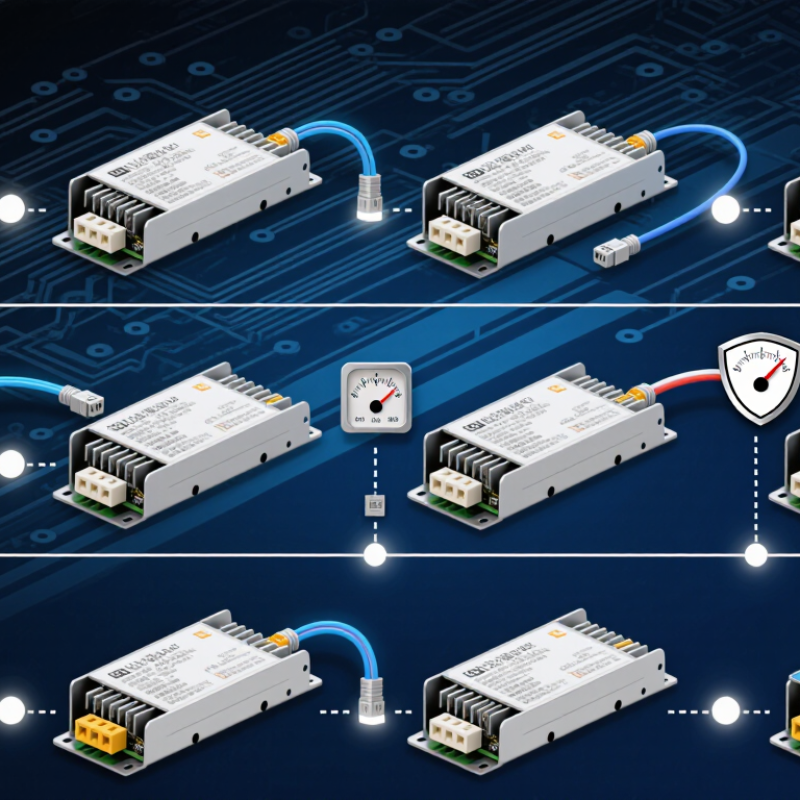
An LED power supply, often called a driver, converts mains electricity into controlled power for LEDs. Most LED chips need regulated current; unstable output can cause flicker, uneven brightness, or premature failure. Some installations use constant-current drivers, while low-voltage strips commonly use constant-voltage supplies. Many units also provide dimming, overload, and temperature protection. Small details matter: a driver rated for a dry indoor ceiling may not suit a damp sign cabinet.
These supplies operate in homes, offices, streetlights, warehouses, vehicle displays, and illuminated signs. In each setting, output, heat, and enclosure protection must match the load and surroundings. The IEA’s Energy Efficiency 2023 report puts lighting at roughly 15% of global electricity use, making efficient conversion an important design consideration. The U.S. Department of Energy’s 2022 Solid-State Lighting R&D Opportunities report also identifies driver efficiency and reliability as ongoing technical priorities. A common oversight is choosing by wattage alone. Check current or voltage, dimming compatibility, ventilation, and expected operating hours too. The perfect match is not always obvious. I would treat advertised lifetime figures cautiously, since real service life depends on heat, installation, and component quality.
How Global Manufacturers Are Evaluated and Ranked
Ranking global LED power supply manufacturers requires more than comparing catalog prices. A reliable evaluation looks at electrical performance, production consistency, and evidence from real operating conditions. Reviewers may test output stability, ripple, efficiency, startup behavior, and protection under overload. Small details matter. A unit that runs cool on a lab bench may behave differently inside a sealed sign cabinet on a hot day.
Manufacturing capability also deserves close inspection. Assess quality-control records, component traceability, factory testing, and how defects are handled. Independent test reports and clear safety documentation strengthen confidence, but paperwork alone is not proof. Ask whether the published ratings include temperature limits and derating guidance. Compare warranty terms, technical response times, and spare-part availability across regions. These details affect installers after delivery, not just purchasing teams.
A fair ranking should explain how each factor is weighted. For example, electrical reliability might count more than a broad product range, while regional support may matter greatly for large projects. Use consistent test methods and disclose gaps in available data. Rankings are imperfect. Some manufacturers provide more public evidence than others, which can influence their apparent position. That limitation should be stated plainly, rather than hidden behind a precise-looking score.
Top 10 LED Power Supply Manufacturers Worldwide
How Global Manufacturers Are Evaluated and Ranked
This illustrative framework assigns relative importance to common evaluation criteria; it does not report measured results or rank specific manufacturers. A real ranking should be based on verified product specifications, certifications, service coverage, and warranty terms.
Profiles of the Top 10 LED Power Supply Manufacturers Worldwide
Profiles of the ten leading LED power supply manufacturers are most useful when they explain what each company actually builds. Compare indoor and outdoor product ranges, available wattages, output voltage, and dimming options. A compact driver for a shop display has different needs from a sealed unit powering outdoor signage. Look for clear datasheets, thermal limits, and stated protection features. Details matter.
Across the field, manufacturers may stand out for custom designs, broad stock ranges, high-efficiency models, or support for large lighting projects. A strong profile should describe production experience and testing practices, not just repeat marketing claims. Check whether specifications are easy to verify and whether technical support can answer installation questions. Some profiles may leave gaps; that is worth noting rather than guessing.
Tips: Match the power supply to the LED load, leave sensible wattage headroom, and check the operating temperature at the installation site. Ask for test reports when performance claims affect your design. A neat label helps, but it is not proof.
How Their Product Ranges, Certifications, and Markets Differ
Comparing the ten leading LED power-supply manufacturers is less about ranking than fit. Some offer compact constant-voltage units for signage and strip lighting. Others emphasize constant-current drivers, programmable dimming, or sealed housings for damp outdoor sites. Look closely at the output range, dimming compatibility, thermal limits, and service life at real operating temperatures. A datasheet’s headline wattage is not the whole story. A ranking can mislead.
Fortune Business Insights estimated the global LED lighting market at USD 75.3 billion in 2023 and forecast USD 164.7 billion by 2032. That expansion brings different regional needs: a retrofit project may prioritize compact dimensions, while a factory installation may require high-temperature operation and stable dimming. Market-access evidence can include IEC 61347-2-13 safety testing, regional electrical listings, and applicable conformity documentation. Requirements vary by product and destination; a certificate for one model does not automatically cover a whole range. Check the exact model number. Check the report scope, too. Market forecasts are useful, but they cannot tell buyers how a driver performs inside a warm, crowded fixture.
How to Compare Manufacturers for Specific Lighting Applications
Compare manufacturers by application, not by wattage alone. Start with the luminaire’s input voltage, operating current, dimming method, and available installation space. A slim indoor panel may need a compact, low-noise supply, while a high-bay fixture needs stable output under sustained heat. Outdoor signs also call for suitable moisture and dust protection. Ask for test conditions behind efficiency, lifetime, and temperature claims; a figure without context is hard to compare.
Tips: Request datasheets, safety documentation, and sample units. Test the supply inside the actual fixture, not only on a bench. Check startup behavior, dimming at low output, and case temperature after several hours. Small details matter.
For a fair comparison, review protection features such as over-temperature, short-circuit, and overload response. Confirm that the manufacturer can explain tolerances and provide consistent documentation across models. If the project requires controls, verify compatibility with the exact dimmer or control protocol. Test real samples. A polished specification sheet can still miss installation problems, and sample testing takes time. That inconvenience is worth planning for before ordering at scale.