Media

WE’RE GETTING NOTICED...

7 Tips for Choosing the Best Clear PVC Film

Choosing the right Clear Pvc Film can affect how well a project looks, performs, and lasts. A roll may seem clear under bright showroom lights, yet show haze beside a window or soften when handled repeatedly. Small details matter. Thickness, surface finish, flexibility, and intended use all deserve attention before you buy.

This guide presents seven practical tips for comparing films with greater confidence. It explains how to assess transparency, check dimensions, and match the material to its setting, from a protective cover to a flexible partition. It also considers temperature exposure, cleaning needs, and the information a supplier should provide. A sample can reveal useful clues, but it cannot always predict long-term performance. That limitation is easy to overlook. Check product specifications, request relevant test data when available, and compare samples under conditions close to your actual use. A film that works well for one application may be unsuitable for another. There is no single best choice for every project. With careful questions and realistic expectations, you can narrow the options and avoid paying for features you do not need. Some comparisons still involve judgment; even experienced buyers can miss a detail. The tips ahead offer a clear starting point, not a substitute for checking the product against your own requirements.
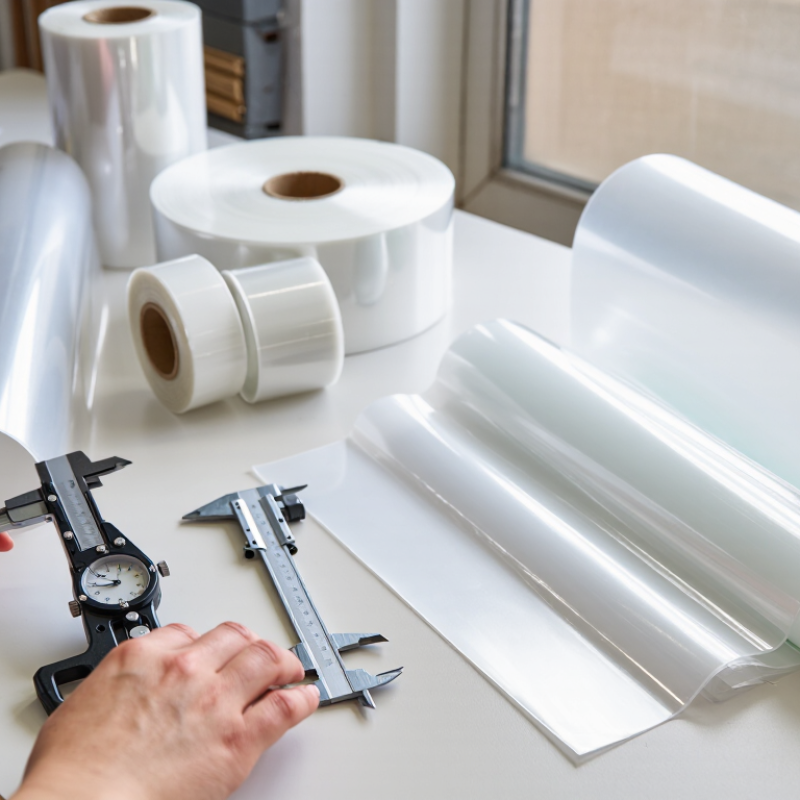
7 Tips for Choosing the Best Clear PVC Film

Define Your Application and Performance Requirements

Before comparing clear PVC films, describe the job they must do. Will the film cover a tabletop, form a flexible window, or protect equipment from dust? Note whether it will stay indoors or face sunlight, rain, temperature swings, or frequent handling. Start with the job.

Then set measurable requirements. For a display cover, optical clarity and low haze may matter most; for a repeatedly handled curtain, flexibility and tear resistance deserve more attention. Record the needed thickness, approximate dimensions, and acceptable level of stiffness. Small details matter. A film that looks clear on a sample card may show wrinkles or distortion once stretched across a frame.

Consider what the film will touch and how it will be cleaned. Oils, cleaning agents, or sharp edges can affect its appearance and service life. Check technical data for relevant properties, but treat figures as a starting point, not a guarantee in your exact setup. I have found that a small trial can reveal practical issues a specification sheet misses. Test a cut sample under real lighting, bend it around the intended edge, and clean it using the planned method. If the film will see cold conditions, test its flexibility there too. Record what changes; even a simple note about clouding or curling helps refine the requirement.

7 Tips for Choosing the Best Clear PVC Film: Define Your Application and Performance Requirements

Start by specifying the film thickness your application requires. This chart converts mils to millimeters using the exact relationship 1 mil = 0.0254 mm. It is a unit-conversion reference, not a recommendation for a particular application.

Compare PVC Film Thickness, Clarity, and Flexibility

Clear PVC film can appear identical on a product page, yet feel very different in use. Thickness affects stiffness, weight, and resistance to creasing. A thin sheet may drape neatly over a curved surface, but can ripple when handled. A thicker sheet often holds its shape better. Thicker is not always better.

Clarity needs more than a bright-looking sample. Hold the film over printed text and check for haze, waviness, or a slight tint. Look through it from several angles, not just straight on. Small distortions may matter when the film covers a display or window. A clear sample can still look cloudy under harsh lighting.

Flexibility is easiest to judge by handling a sample. Bend it gently around a familiar object, such as a mug, and notice whether it creases or springs back. Feel the difference. Compare samples at the same temperature, since PVC can feel less pliable in cooler conditions. This quick check is useful, but imperfect: a small sample may not behave like a full sheet. Match thickness, clarity, and flexibility to the actual application, then test the chosen film in place before ordering a larger quantity.

7 Tips for Choosing the Best Clear PVC Film - Compare PVC Film Thickness, Clarity, and Flexibility

Tip What to Compare Typical Options or Data How to Choose
1. Match thickness to the job Film thickness and the support the application provides Common clear flexible PVC film thicknesses include approximately 0.10–0.50 mm; heavier-duty sheets are also available. Thinner film is easier to fold and handle. Choose thicker film when more body and resistance to tearing or puncture are important.
2. Check clarity with a measurement Visible-light transmission and haze Clear PVC formulations can have visible-light transmission in roughly the 80–90% range. Results vary with thickness, additives, surface finish, and test method. For display windows or covers, request a transmission and haze test report for the specific thickness rather than relying on the word “clear.”
3. Consider flexibility at the working temperature Softness, bendability, and performance in cold or warm conditions Flexible PVC contains plasticizers; formulation affects flexibility. PVC generally becomes less flexible as temperature falls. For repeated folding or use in cool environments, ask for samples and test them at the expected service temperature.
4. Test the bend radius Whether the film creases or cracks when bent around an edge There is no single bend-radius value for all clear PVC films; thickness, formulation, temperature, and bending frequency all matter. Make a bend test using the intended edge or roll diameter. For frequent movement, check for whitening, permanent creases, or cracking.
5. Balance strength and handling Tensile strength, tear resistance, and ease of cutting Mechanical properties depend on the film grade and test method, so they should be compared using the supplier’s data sheet. Request test values for the intended thickness. A sample trial can confirm whether the film cuts, welds, or handles as required.
6. Verify the surface and finish Gloss, surface texture, and optical distortion Clear PVC film may be supplied with smooth or textured surfaces. Surface finish can affect reflections, visibility, and ease of cleaning. Inspect the film under the lighting and viewing conditions where it will be used, especially for windows and display covers.
7. Check compatibility and service conditions Exposure to sunlight, cleaners, oils, and other materials UV resistance and chemical compatibility depend on the PVC formulation; not every clear film is intended for outdoor or chemical exposure. Confirm the intended exposure with the supplier and test contact with the actual cleaners or materials before placing a large order.

Figures and ranges are general selection guides, not guaranteed specifications. Confirm optical and mechanical properties for the exact film grade, thickness, and test method.

Assess Durability, Weather Resistance, and Safety

Clear PVC film can look robust indoors yet weaken after repeated sun, rain, and temperature changes. Check the technical sheet for tensile strength, thickness tolerance, and stated service conditions. ASTM D882 measures tensile properties, while ASTM G154 provides a controlled method for fluorescent-UV exposure. Ask suppliers for test results before and after weathering, not just a fresh-roll sample. Small details matter: a film stretched tightly across a frame may fail sooner at sharp corners.

Exposure varies by site. The U.S. Environmental Protection Agency reports that fresh snow can reflect up to 80% of incoming UV radiation, increasing exposure around outdoor installations. That figure makes sheltered-use claims a poor fit for snowy locations. Safety also depends on the application. Request the safety data sheet and, for food-contact or child-facing uses, appropriate migration and material-compliance documentation. Clear film alone proves nothing about chemical suitability. Inspect a sample for haze, tackiness, edge cracking, and odor after realistic exposure. I would not judge it from one sunny afternoon; that is an easy mistake. A written replacement interval helps, though actual wear may still surprise you.

Check Manufacturing Quality and Supplier Specifications

Clear PVC film should arrive with measurable specifications, not just a glossy sample. Ask for nominal thickness and tolerance, resin grade, tensile strength, haze, and light-transmission results. Request test methods, test conditions, and recent batch certificates. ASTM D1003 covers haze and luminous transmittance for transparent plastics; ASTM D882 measures tensile properties of thin plastic sheeting. These methods make supplier comparisons more meaningful. Ask for the actual test record, too. A specification without results is only a promise.

Check whether the supplier tracks production lots and can link each roll to its test records. Request sample reports, equipment-calibration dates, and written procedures for handling out-of-spec material. PlasticsEurope’s 2023 report, Plastics – the Fast Facts, estimates global plastics production at 400.3 million tonnes in 2022. That figure covers plastics broadly, not clear PVC film, but it underscores why traceability matters across a large, varied supply chain. Keep it in writing.

A clear sample can still conceal uneven thickness, weak edges, or haze that appears after forming. I would not treat one good sample as proof. Compare several rolls, and inspect them under the lighting and temperature conditions of your intended use. Some details are easy to miss.

Balance Cost, Customization, and Long-Term Value

Clear PVC film is rarely a lowest-price purchase alone. Compare usable area, expected service life, and replacement frequency. PlasticsEurope’s Plastics—the Fast Facts 2023 estimates global plastics production at 400.3 million tonnes in 2022, with PVC representing 12.8%. That scale reflects broad industrial use, not proof that every film grade suits your application.

A low quote can hide narrow rolls, excess trim waste, or unsuitable thickness. Compare cost per usable square metre, then request samples. Check clarity under shop lighting, flexibility in cold conditions, and whether the film resists the cleaning products you actually use. Small differences matter. Custom options such as UV protection or anti-static treatment may reduce premature replacement, but can raise minimum orders and lead times. Ask suppliers to price standard and customized specifications side by side.

VinylPlus’s 2023 Progress Report records 731,461 tonnes of PVC recycled in Europe in 2022. That figure covers PVC broadly; it does not guarantee that a particular clear film is locally recyclable. Confirm the film’s additives and local collection options before treating recyclability as a cost benefit. For long-term value, compare warranty terms, cleaning requirements, and replacement intervals—not just the initial roll price. It is an imperfect calculation, especially when use conditions change. A simple trial installation can expose problems before a large order.