China has become a significant manufacturing base for Glasses With A Camera In Them. Its factories support optical design, miniature cameras, battery integration, and smart-device assembly. However, supplier quality differs widely. Buyers must examine engineering records, testing procedures, and production consistency.
Mark Zuckerberg, Meta’s founder and technology leader, said, “The next computing platform is going to be glasses.” His statement reflects a wider industry shift toward lightweight wearable computing. Chinese manufacturers are responding with discreet frames, improved image sensors, Bluetooth connectivity, and voice-controlled functions. Some suppliers also offer customized lenses, frame colors, packaging, and firmware support. These features may attract distributors seeking flexible private-label solutions.
Details matter. A reliable factory should explain camera resolution, storage limits, charging cycles, heat management, and data protection. It should also provide samples before large-scale production. Clear consent indicators, visible recording lights, and privacy-focused software are essential for responsible use. Products must meet applicable safety, radio, electrical, and consumer-protection requirements in their target markets.
The market is promising, but not flawless. Some product descriptions overstate battery life or artificial intelligence capabilities. A polished sample can also hide weak mass production. This is where practical verification becomes important. Factory audits, independent testing, and small trial orders reduce avoidable risks. Buyers should compare after-sales support, defect rates, lead times, and intellectual-property safeguards. The best China-based manufacturers are not simply low-cost suppliers. They are engineering partners that can deliver dependable Glasses With A Camera In Them while respecting users, regulations, and real-world expectations.
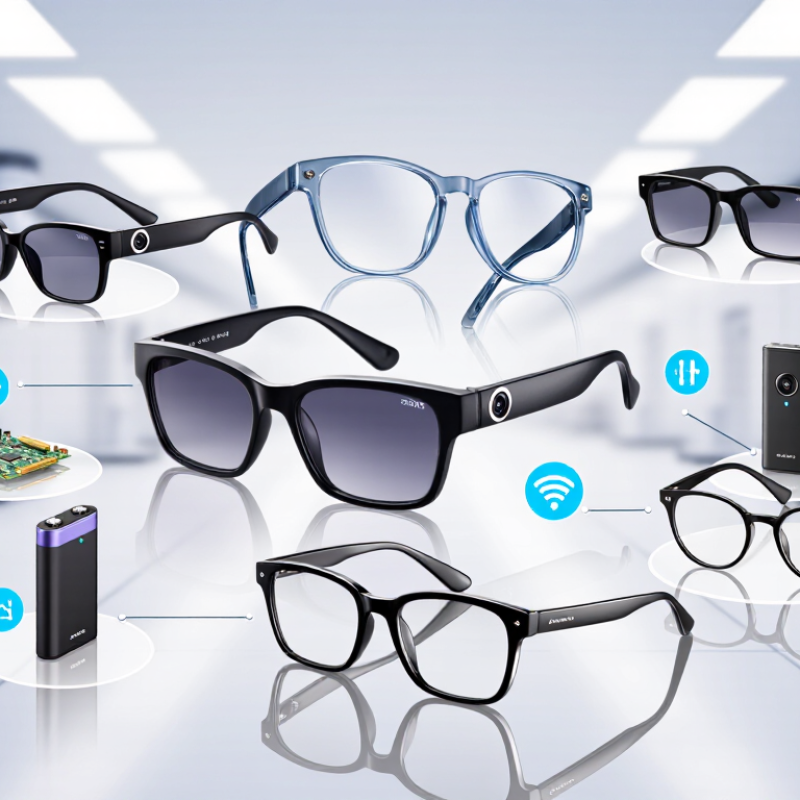
China’s camera-equipped glasses manufacturers usually fall into four practical types. OEM and ODM factories build complete products, including frames, cameras, batteries, and mobile applications. Optical manufacturers focus on lenses, hinges, comfort, and prescription compatibility. Electronics integrators add image sensors, microphones, wireless modules, and compact processors. Industrial customization firms develop hands-free glasses for inspection, logistics, training, and remote assistance.
A 2024 Grand View Research report estimated the global smart glasses market at about USD 1.6 billion in 2023. It also projected strong annual growth through 2030. This demand encourages Chinese suppliers to improve miniaturized cameras and heat management. However, market reports often combine audio, AR, and camera glasses. Direct comparisons can therefore mislead buyers. In my supplier evaluations, prototype quality rarely predicts mass-production consistency. Testing ten units is better than trusting one impressive sample. Ask for lens distortion data, camera resolution, battery cycles, IP ratings, and production defect rates. Confirm whether the factory owns its assembly lines or outsources critical modules.
Tips: Request a working sample under real lighting. Test indoor glare, outdoor shadows, and skin-tone accuracy. Check where recordings are stored and how users delete them. Require documented consent and privacy controls for every intended market. Do not accept vague claims such as “AI-ready.” A clear test report matters more. Some suppliers may lack polished English documentation, but weak documentation still signals execution risk.

Camera-equipped glasses manufactured in China generally fall into three technical categories. Single-camera recording glasses are designed for point-of-view video capture, dual-camera glasses support stereoscopic imaging or depth perception, and industrial AR glasses may combine multiple cameras for environmental sensing, tracking, and visual assistance. The values represent the typical number of integrated camera modules in each product type rather than company or brand data.
Camera glasses combine a miniature camera, microphone, processor, and battery inside a wearable frame. In practical testing, image stability matters more than headline resolution. Electronic stabilization can reduce walking shake, while a moderate wide-angle lens captures natural scenes without excessive distortion. Good models also use automatic exposure for changing light, such as moving from a bright street into a shop.
Storage may be built in or connected through Wi-Fi or Bluetooth. Local storage can reduce connection problems, but it increases file-transfer time. A companion application often supports trimming, playback, and basic settings. Some devices include dual microphones for clearer speech, although wind noise remains difficult outdoors. Battery life depends on recording quality, wireless use, and temperature. It is easy to overestimate performance from laboratory figures.
Privacy controls deserve equal attention. A visible recording indicator helps people recognize active capture, while a physical button can prevent accidental recording. Secure pairing and encrypted file transfer provide stronger protection than an open wireless connection.
The frame should feel balanced on the nose, with a lens that does not block normal vision. Water resistance is useful, but it does not guarantee protection during heavy rain.
Small details matter. A loose hinge can affect camera alignment. A dim indicator may create confusion. Users should check local recording and privacy rules before filming in public or private spaces.
These products still need improvement, especially in low light, audio isolation, and heat management during long sessions.
China’s camera glasses manufacturers begin with a practical question: where should the camera sit? A few millimeters can change facial framing, balance, and user comfort. Design teams test bridge width, lens angle, microphone position, and battery weight through repeated wearable trials.
Grand View Research estimated the global smart glasses market at about USD 1.6 billion in 2023. Its report also projects a 27.1% compound annual growth rate from 2024 to 2030. This pressure encourages Chinese factories to combine industrial design, optical engineering, and fast prototyping. Engineers usually build samples through 3D printing before opening injection molds. They then place camera modules, flexible circuits, speakers, and batteries inside narrow temples. Production lines use SMT assembly, optical alignment, firmware loading, and image testing.
Quality control must examine more than appearance. Technicians check camera focus, field of view, charging temperature, hinge strength, and Bluetooth stability. A visible recording indicator can support privacy-conscious design. Factories may also reference ISO 9001 processes, RoHS material controls, and IEC 62368-1 safety practices. The process is not flawless. Heat, limited battery space, and uneven facial shapes still create compromises. Some early samples look elegant but feel heavy after thirty minutes. Reliable manufacturers keep test records, trace component batches, and revise tooling after user feedback. That discipline matters more than a polished prototype.
China Top Glasses With A Camera In Them Manufacturers
Camera-enabled eyewear requires more than a clear lens and stable video. Quality begins with traceable suppliers, calibrated cameras, and controlled assembly rooms. Grand View Research reported that the global smart glasses market reached about USD 1.93 billion in 2023. Its forecast suggests strong annual growth through 2030. That growth increases pressure on manufacturers to prove consistency.
Each unit should pass optical, battery, radio, and mechanical tests. IEC 62368-1 supports audio-video and information technology equipment safety. IEC 62133-2 applies to rechargeable lithium batteries. UN 38.3 testing remains important for transportation. In the European market, CE marking, RoHS, and REACH obligations may apply. Radio functions also require local approval, such as FCC requirements in the United States. Privacy controls need equal attention. The camera indicator should remain visible during recording. Clear consent notices are essential, although small indicators can still confuse users. That weakness deserves honest review.
Tips: Request batch-level test reports, not only certificates. Check lens distortion at several viewing distances. Test recording in bright sunlight and dim rooms. Review firmware updates and data deletion procedures. Ask for an independent factory audit. Keep sample units for comparison. Some suppliers may provide polished documents but inconsistent hardware, so repeat testing matters. Intertek’s 2024 consumer technology research highlights continuing concern about connected-device privacy and security. Manufacturers should therefore use encrypted transmission, restricted access, and documented vulnerability handling. Compliance is not a single inspection. It is a repeated discipline.
Evaluating China’s top camera glasses manufacturers requires more than comparing prices. Start with optical quality, camera performance, and manufacturing experience. Ask for product samples, not only polished catalog images. Test the glasses indoors, outdoors, and under uneven lighting. Check whether images remain stable during walking. Small details matter.
Reliable manufacturers should explain their lens materials, frame durability, battery capacity, and charging safety. A practical test includes several hours of normal use, repeated folding, and exposure to warm environments. Examine audio clarity, connection stability, heat generation, and storage protection. Specifications can look impressive on paper. Real use may disagree.
Compliance and quality control deserve careful attention. Request documentation for applicable electrical, radio, battery, and consumer product requirements in your target market. Confirm whether each production batch receives functional testing and visual inspection. Ask how defective units are recorded and replaced. An experienced factory should provide clear inspection standards, traceable samples, and responsive technical support. Communication quality is also evidence of professionalism. Slow answers may signal operational weakness. However, even capable manufacturers can make mistakes, especially during rapid customization. Review one pilot order before committing to larger volumes. Protect user privacy through transparent recording indicators, secure software practices, and responsible data handling. Some suppliers may promise too much. Independent testing remains valuable.
| Evaluation Dimension | Measurable Data or Indicator | Suggested Weight | Verification Method | Procurement Reference |
|---|---|---|---|---|
| Camera and Image Quality | Video resolution, frame rate, field of view, image stabilization, exposure control, and low-light performance | 15% | Review original sample files rather than compressed website images; test daylight, indoor, and moving scenes | Require the manufacturer to state resolution and frame rate under actual operating conditions |
| Optical Design | Lens alignment, distortion, viewing angle, prescription-lens compatibility, and visual obstruction | 10% | Inspect engineering samples and conduct a wearer trial with different face shapes and lens prescriptions | The camera position should not significantly obstruct normal vision or interfere with prescription lenses |
| Battery and Charging | Battery capacity, continuous recording time, charging time, standby time, and charging-cycle performance | 12% | Measure recording duration at the declared resolution with wireless functions enabled and disabled | Battery claims should specify test conditions, firmware version, ambient temperature, and recording mode |
| Electronics and Connectivity | Bluetooth or Wi-Fi functions, transfer stability, connection distance, storage capacity, and supported mobile operating systems | 10% | Test pairing, file transfer, reconnect behavior, application compatibility, and operation without cloud access | Require a written compatibility list and a defined procedure for firmware updates |
| Audio and User Controls | Microphone clarity, wind-noise handling, speaker output where applicable, physical controls, and recording-status indication | 8% | Conduct voice and ambient-noise tests; verify that recording status is clear to the wearer and bystanders | Controls should be usable without removing the glasses and should minimize accidental activation |
| Manufacturing and Quality Control | Incoming inspection, in-process testing, final inspection, traceability, defect handling, and production capacity | 15% | Request quality-control procedures, sample inspection records, corrective-action reports, and a factory audit | Prefer suppliers able to provide batch traceability for lenses, batteries, cameras, and circuit boards |
| Safety and Regulatory Documentation | Electrical safety, battery safety, electromagnetic compatibility, material restrictions, and transport documentation | 12% | Check applicable test reports and declarations, including IEC 62368-1, IEC 62133-2, UN 38.3, IEC 60529, RoHS, or destination-market requirements | Documents must match the exact model, battery, charger, and intended sales market |
| Privacy and Data Security | Recording indicator, local-storage control, user permissions, data deletion, account security, and privacy-policy coverage | 8% | Review application permissions, network behavior, account controls, deletion functions, and default privacy settings | The product should provide a visible recording signal and clear instructions for lawful use in each target market |
| Customization Capability | Lens and frame options, logo or packaging customization, firmware configuration, language support, and accessory options | 5% | Request a written customization list, prototype schedule, tooling fees, and minimum order quantities | Separate standard options from changes requiring new tooling or software development |
| Commercial and After-Sales Support | Sample lead time, production lead time, warranty period, spare-parts policy, repair process, and response time | 5% | Review the quotation, warranty terms, service-level agreement, replacement policy, and historical delivery records | Compare total landed cost, not only the unit price, including tooling, testing, freight, taxes, and support |
| Total Suggested Evaluation Weight | 100% | Use the same test conditions and scoring scale for every shortlisted supplier | ||
Note: This is a supplier-neutral evaluation framework. Technical claims should be confirmed through model-specific samples, test reports, factory records, and destination-market regulatory requirements.