Children Learning Flash Card products help turn small moments into practical learning experiences. A child can match a red apple, name its color, and repeat the word beside a parent. The cards may look simple. Their design is not.
This guide introduces China’s top 10 Children Learning Flash Card manufacturers through a practical, evidence-based lens. The evaluation considers educational quality, card durability, printing accuracy, child-safe materials, factory capabilities, customization, minimum order quantities, and delivery reliability. It also reviews how manufacturers support phonics, vocabulary, numbers, visual recognition, and early bilingual learning. Dr. Maria Montessori, a respected authority in early childhood education, said, “The hand is the chief teacher of the brain.” Her principle remains relevant when children hold, sort, turn, and discuss each card.
Real purchasing decisions need more than attractive product photos. Buyers should request material specifications, safety-test documentation, production samples, and clear quality-control procedures. A glossy finish may look impressive, yet it can create glare under classroom lighting. Thin cards may lower costs, but they often bend quickly in active hands. Some suppliers also offer excellent printing while providing limited educational guidance. That difference matters.
The ranking is not permanent. Markets change. Factory performance can vary between orders. This article therefore combines supplier information, product observations, manufacturing experience, and buyer-focused criteria. It may not capture every regional strength, and some judgments remain open to debate. Still, it offers a useful starting point for educators, distributors, retailers, and parents seeking dependable learning tools from China.
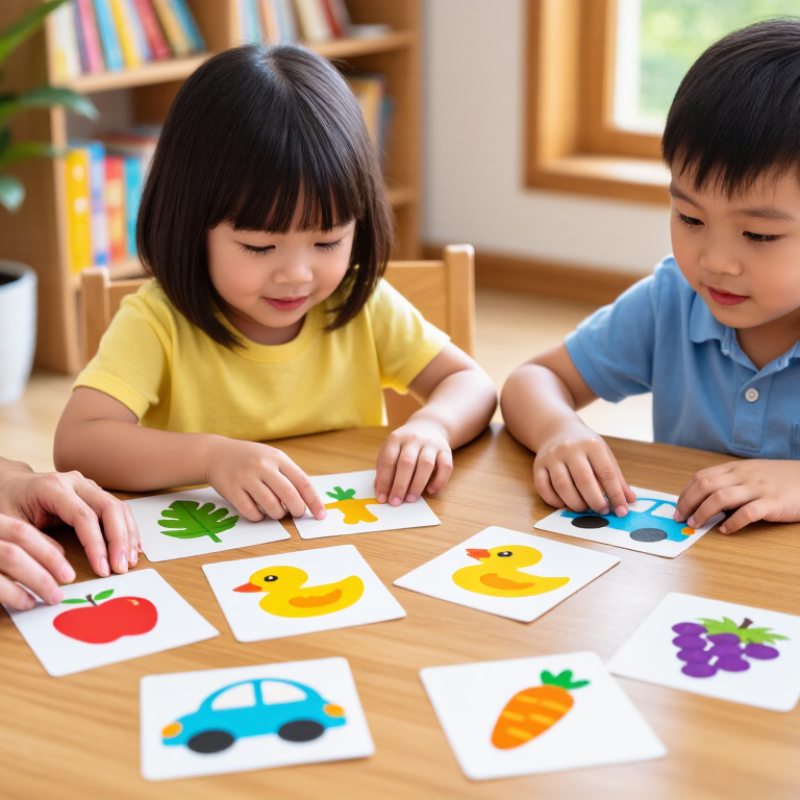
What Children’s Learning Flash Cards Are and How They Support Learning
Children’s learning flash cards are small cards with prompts, pictures, letters, numbers, or simple questions. A child sees one side, recalls the answer, then checks the reverse. This turns passive viewing into active retrieval. Dunlosky and colleagues’ 2013 review rated practice testing and spaced practice as highly effective learning techniques. The 2023 UNESCO Global Education Monitoring Report also stresses that learning tools need clear purpose, guidance, and suitable context.
In daily learning, flash cards can strengthen vocabulary, phonics, counting, and memory. A picture of a red apple can support the word “apple,” while dotted numbers can guide early counting. Short sessions reduce pressure. Repeated review helps move knowledge from quick recognition toward reliable recall. Yet cards are not magic. Too many cards can create guessing, boredom, or shallow memorization. Children also need stories, conversation, movement, and real objects. This is where many learning plans become incomplete.
Tips: Use five to ten cards per session. Ask the child to explain, not only answer. Mix familiar and new cards. Review difficult cards after a short break. Watch facial expressions and errors; they reveal when the set is too easy or too demanding. Avoid correcting every mistake immediately. Give thinking time. Track progress weekly, but treat the record as evidence, not a final judgment.
The table below compares ten widely produced children’s learning flash-card formats and their educational applications. It focuses on product characteristics, learning functions, and commonly used manufacturing specifications rather than company or brand information.
| No. | Flash Card Category | Typical Age Range | Common Card Format | Primary Learning Goal | How It Supports Learning | Common Materials and Features | Important Quality Considerations |
|---|---|---|---|---|---|---|---|
| 1 | Alphabet and Phonics Cards | 3–7 years | Large letter, picture, and pronunciation guide | Letter recognition and early phonemic awareness | Connects letter shapes with sounds and familiar objects through repetition and recall. | Coated paper or laminated board; rounded corners; high-contrast illustrations | Clear typography, accurate pronunciation content, durable lamination, and non-sharp edges |
| 2 | Early Vocabulary Cards | 2–6 years | Picture on the front with word or short phrase on the back | Noun, verb, adjective, and category vocabulary | Encourages naming, matching, sorting, and simple sentence-building activities. | Thick paperboard, matte coating, colorful images, and child-sized cards | Images should be recognizable, culturally appropriate, and printed with stable colors |
| 3 | Numbers and Counting Cards | 3–7 years | Numeral paired with dots, objects, or number words | Counting, numeral recognition, and one-to-one correspondence | Helps children associate written numerals with quantities and compare groups. | Laminated board, large numerals, tactile or visual counting symbols | Consistent counting layouts, readable symbols, and age-appropriate number ranges |
| 4 | Shapes and Colors Cards | 2–5 years | Single shape or color per card with matching prompts | Visual discrimination, classification, and descriptive language | Develops observation skills by asking children to identify, match, and group visual properties. | Gloss or matte laminated card stock; bold shapes; color-coded backgrounds | Accurate color reproduction, sufficient contrast, and layouts suitable for color discussion |
| 5 | Animals and Nature Cards | 2–7 years | Animal or nature image with name and short fact | General knowledge, classification, and oral language | Promotes question-and-answer practice, category grouping, and knowledge retention. | Printed paperboard, photographic or illustrated images, optional information panels | Factually accurate labels, clear species images, and age-appropriate information density |
| 6 | Early Reading and Sight-Word Cards | 4–8 years | Word, short sentence, or word-picture pairing | Word recognition, decoding practice, and reading fluency | Provides short, repeatable practice that supports recognition of common words and simple patterns. | High-opacity card stock, large text, phonics cues, and optional answer side | Correct spelling, consistent reading level, strong text contrast, and adequate line spacing |
| 7 | Bilingual Language Cards | 3–8 years | Image with two-language labels and pronunciation support | Vocabulary development across two languages | Supports word association, listening practice, and communication between children and caregivers. | Laminated board, dual-language text blocks, phonetic guides, and optional audio elements | Professional translation, consistent terminology, correct pronunciation, and readable text hierarchy |
| 8 | Science and Human-Body Cards | 5–10 years | Diagram, labeled illustration, and short explanation | Basic science concepts and factual recall | Introduces classification, sequencing, cause-and-effect, and subject-specific vocabulary. | Durable board, labeled diagrams, thematic sets, and question-and-answer backs | Scientifically accurate illustrations, age-appropriate explanations, and legible labels |
| 9 | Social-Emotional Learning Cards | 3–8 years | Emotion faces, social situations, and discussion prompts | Emotion identification and interpersonal communication | Encourages children to name feelings, consider perspectives, and discuss appropriate responses. | Thick card stock, expressive illustrations, scenario prompts, and rounded corners | Inclusive imagery, sensitive wording, non-stereotypical scenarios, and safe handling design |
| 10 | Reusable Activity and Matching Cards | 3–8 years | Pairs, sequences, sorting cards, or wipe-clean activity cards | Memory, reasoning, sequencing, and fine-motor practice | Turns recall into a game-based activity involving matching, ordering, problem-solving, and repetition. | Heavy laminated board, rounded corners, dry-erase surface, and storage box or ring | Strong adhesion, scratch resistance, clean cut edges, durable packaging, and reliable card pairing |



All Rights Reserved. EI Robotica 2023.