China Best Round Trampoline Manufacturers and Suppliers
China’s trampoline industry includes factories of different sizes, capabilities, and quality-control practices. Choosing a Round Trampoline supplier therefore takes more than comparing catalog photos or unit prices. Frame tubing, spring layout, mat stitching, enclosure netting, and padding all affect how a product performs after repeated outdoor use. Small details matter.
This guide introduces manufacturers and suppliers in China and explains what buyers can examine before requesting a quotation. Ask for clear product specifications, material details, production capacity, sample options, and inspection records. Where available, review relevant test reports and confirm which model they cover; a document for one design may not verify another. Check how suppliers manage weld consistency, corrosion protection, UV exposure, packaging, and replacement parts. These questions help turn broad claims into verifiable details.
A factory visit or independent inspection can reveal practical issues that a polished brochure may not show. Still, no checklist guarantees a trouble-free order. Compare written specifications against a physical sample, especially around frame joints and net attachment points. Those areas deserve attention. Buyers should also clarify minimum order quantities, lead times, customization limits, and after-sales support in writing. The right partner is not always the cheapest or largest. It is the supplier whose evidence, communication, and production process fit the intended market and use. Supplier capabilities can change, so verify current details directly before placing an order.
Understanding Round Trampolines and Their Main Applications
A round trampoline uses a circular jumping mat, evenly spaced springs, and a frame designed to support recreational bouncing. Its shape can help guide movement toward the center, but it does not prevent falls. Mat size, spring tension, and frame stability all affect how it feels underfoot. Check the rated user weight and intended age range before choosing one.
At home, round models are commonly used for supervised family play and basic fitness routines. Schools or recreation spaces may use them for structured activities, provided the equipment matches the users and setting. A safety enclosure, padded frame, and clear space around the trampoline matter. So does careful installation on level ground. One detail is easy to overlook: a larger jumping area also needs more clearance.
Tips: Measure first. Keep the entry closed during use. Allow one jumper at a time, and inspect springs, stitching, and padding regularly. Follow the supplier’s assembly and care instructions. If the bounce feels uneven, stop using it and check the setup; that small pause is worth it.
China’s Round Trampoline Manufacturing Industry
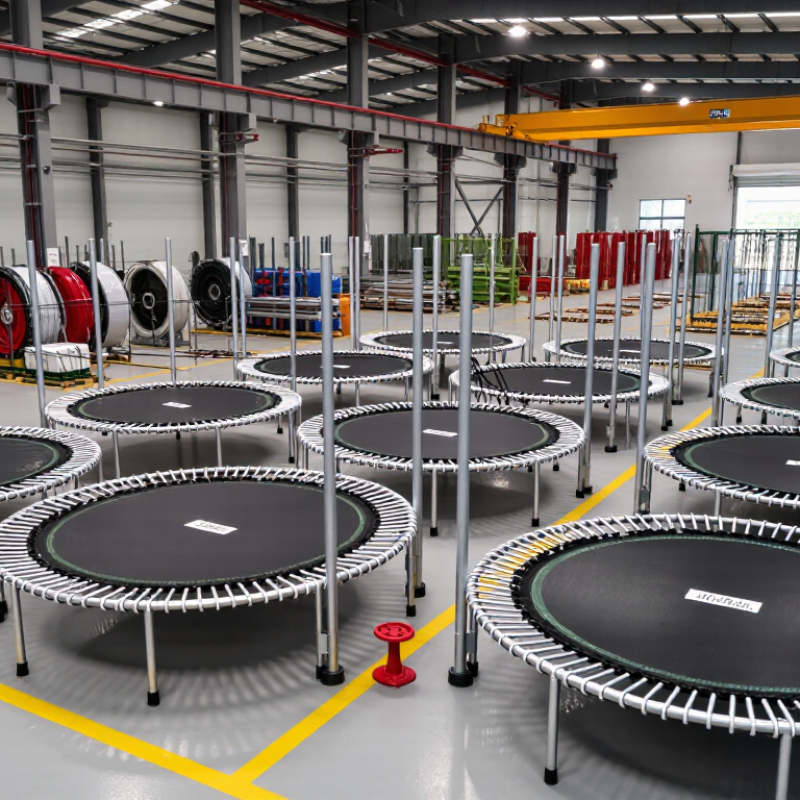
China’s round trampoline manufacturing industry brings together steel processing, spring making, fabric cutting, sewing, and assembly. Many factories form circular frames from galvanized steel tubing, then join the sections by welding or bolts. The circle looks simple. Small gaps matter. Uneven joints can affect frame stability and how evenly the jumping mat sits.
Production quality depends on more than machinery. Buyers can ask how suppliers check tube thickness, welds, spring dimensions, stitching, and protective padding. A close look at a sample may reveal loose thread, rough edges, or a cover that shifts over the frame. These details are easy to miss in a product photo. Specifications should also state trampoline size, user capacity, and included parts clearly.
Manufacturers differ in equipment, experience, and inspection routines, even within the same region. A factory visit or a third-party inspection can help verify processes, but neither makes every defect impossible. No inspection plan is flawless. I would compare samples against written specifications and keep records of any changes before bulk production. That extra care can feel slow, yet it often prevents confusion when a shipment arrives with parts that do not fit as expected.
How to Evaluate Chinese Trampoline Manufacturers and Suppliers
When evaluating Chinese round trampoline manufacturers and suppliers, look beyond catalog photos and quoted prices. Ask how the frame is made, what steel specifications are used, and how the tubes are protected against corrosion. A smooth coating matters, but inspect welds, joints, and sharp edges too. Small defects can become obvious after repeated assembly.
Request recent test reports and confirm that they match the exact model and configuration you plan to buy. Check the jumping mat, springs, enclosure net, and padding separately; one strong component does not prove the whole trampoline is durable. Ask for production lead times, sample policies, packaging details, and a written process for handling defects. A video call from the production floor can help, though it cannot replace independent inspection. I might still miss something from a distance.
Tips: Compare the same specifications across at least three suppliers. Request close-up photos of stitching, spring hooks, and frame connections. Clarify who pays for sample shipping and what happens if an inspection finds a problem. Keep answers and approved specifications in writing. Be cautious of unusually low prices or vague responses. A careful supplier should explain limitations, not promise that nothing will fail.
Round Trampoline Sizes: Diameter Conversion
The chart compares common nominal round trampoline diameters in feet, converted to meters using 1 ft = 0.3048 m. Use these dimensions as a consistent starting point when comparing product specifications from manufacturers and suppliers.
Profiles of Notable Chinese Round Trampoline Manufacturers
Chinese round trampoline manufacturers tend to cluster around a few strengths: steel-frame fabrication, mesh sewing, or export-oriented assembly. Some suppliers offer custom diameters and enclosure layouts, while others focus on standardized models for faster production. Buyers should examine frame-gauge specifications, weld finishing, spring counts, and replacement-part availability—not just catalog photos. A close look matters.
Grand View Research estimated the global trampoline market at USD 3.6 billion in 2022 and projected a 5.4% compound annual growth rate through 2030. This points to sustained demand, but it does not verify any individual factory’s capacity or quality. Factory audits, sample testing, and clear inspection records remain essential. ASTM F381 provides a relevant safety benchmark for trampoline design and performance; suppliers should explain which tests their products have undergone. Ask for dated reports, not just a standards logo. Details can be uneven. Even a neatly sewn enclosure may hide inconsistent stitching or weak attachment points, so hands-on checks can reveal issues that a polished brochure misses.
Sourcing, Quality Assurance, and Import Considerations
China Best Round Trampoline Manufacturers and Suppliers
Sourcing, Quality Assurance, and Import Considerations
China offers a broad supplier base for round trampolines, but quotations need careful comparison. Grand View Research projects the global trampoline market will grow at a 5.9% compound annual rate from 2024 to 2030. That outlook suggests continued demand, not guaranteed supplier reliability. Ask for material specifications, production capacity, and recent test records before comparing prices.
Check frame-tube thickness, weld consistency, spring finish, mat stitching, and enclosure-net strength. Request documented tests for corrosion, UV exposure, and repeated loading. ASTM F381 provides safety and performance requirements for trampoline systems; confirm that the exact model and configuration were evaluated. Inspect a pre-production sample, then use lot-based checks before shipment. Small stitching defects matter.
They can spread.
For imports, confirm carton dimensions, gross weight, spare-part availability, and agreed inspection terms before production. Ask the supplier to identify the product’s customs classification and provide accurate commercial documents; verify requirements with a qualified customs broker in the destination market. Product rules and duties vary by country. A useful audit includes photos of packing, serial or batch identification, and inspection records. One weakness in many sourcing plans is relying on a certificate without checking its scope, date, and model coverage.