Media

WE’RE GETTING NOTICED...

Best Smart Exercise Bike Manufacturers in China?

Choosing among the best Smart Exercise Bike manufacturers in China takes more than comparing prices or glossy product photos. A useful evaluation begins with the ride itself: Does resistance change smoothly? Can the console hold a stable connection? Do the pedals feel secure after repeated testing? Small details matter. So does after-sales support.

Exercise physiologist Dr. Fabio Comana’s guidance can be paraphrased this way: training should be appropriate, progressive, and sustainable. That principle applies to connected bikes, too. A feature-rich screen is not enough if the riding position feels awkward or workout data is unreliable. Buyers should examine prototype testing, component traceability, software-update plans, and spare-parts availability. Ask for evidence, not just promises.

This outline compares Chinese manufacturers by product engineering, customization, quality-control practices, connectivity, and export support. It also considers how clearly each supplier documents testing and handles defects. A factory tour or sample order may reveal more than a polished catalog. Yet no single checklist guarantees a dependable partnership. Some details remain hard to judge until real riders use the bike for weeks. That is an uncomfortable gap—and worth admitting. The strongest shortlist should balance measurable specifications with direct questions about production capacity, service response, and long-term maintenance.
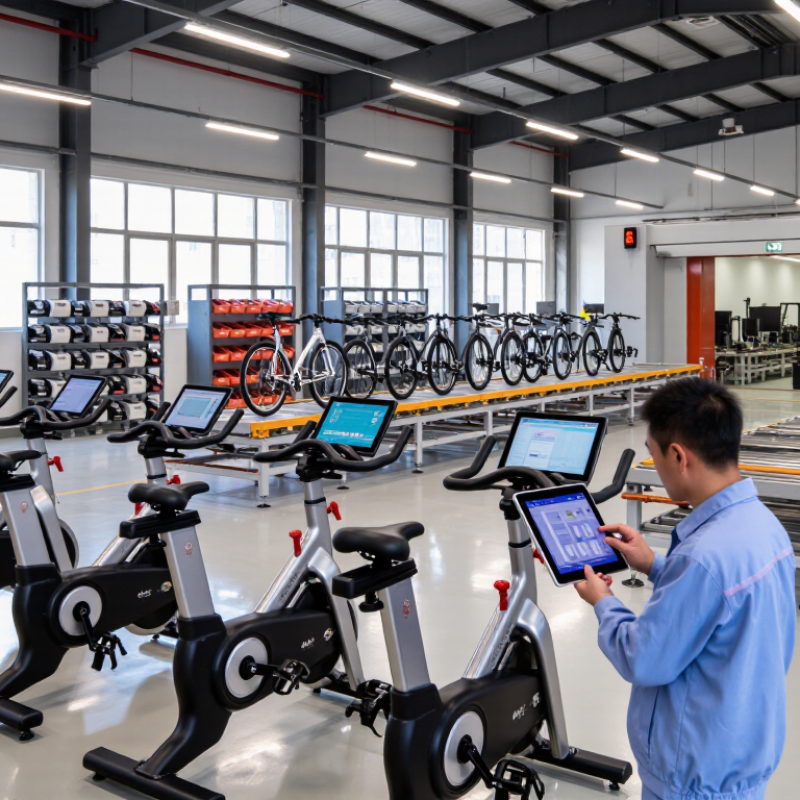
Best Smart Exercise Bike Manufacturers in China?

Understanding Smart Exercise Bikes and Their Key Features

A smart exercise bike connects riding data with adjustable resistance and guided workouts. Depending on the design, sensors may track cadence, heart rate, power, and workout duration. These numbers help riders compare sessions, but accuracy varies between sensors and models. Check whether heart-rate readings come from the bike or a separate wearable. Small detail. It can affect training decisions.

Resistance control is another key feature. Some bikes change resistance automatically during a class; others require manual adjustment. A smooth transition matters when a route shifts from a flat road to a steep climb. Before choosing a manufacturer, review the bike’s maximum user weight, adjustment range, and stated noise level. If possible, test the saddle and handlebars in person. A quiet flywheel does not guarantee a comfortable ride.

Connectivity deserves careful attention, too. Confirm which phones or tablets are supported, whether core features work without a paid subscription, and how workout data can be exported. Ask about replacement parts and service response times, not just the warranty period. These practical details are easy to overlook. A polished screen may impress in a showroom, while an awkward seat becomes obvious after twenty minutes. Product specifications help, but they cannot replace a real test ride.

China’s Smart Exercise Bike Manufacturing Industry

China’s smart exercise bike industry sits within a much larger sports-manufacturing ecosystem. The National Bureau of Statistics reported that China’s sports industry added about 1.49 trillion yuan in value in 2023. That figure covers the whole sector, not exercise bikes alone. It signals scale, but cannot prove how many connected bikes factories produce.

Production combines familiar metalwork with electronics and software. A typical line may cut and weld steel tubing, apply a powder-coated finish, then fit sensors, a resistance unit, and a console. Suppliers in coastal manufacturing regions can often source components nearby, although supplier access does not guarantee consistent quality. Small details matter: a loose crank, noisy belt, or cadence reading that drifts during a test ride can undermine the product. Look for documented endurance, resistance-accuracy, and connectivity tests, rather than relying on a polished showroom sample. Ask how firmware updates and replacement parts are handled. Practical questions.

Industry data needs careful reading. Broad reports on sports output do not isolate smart-bike factories, export quality, or app reliability. Buyers should request model-specific test records and inspect a production sample when possible. A few factories may still rely on manual checks; that is worth questioning, not automatically disqualifying. China offers deep manufacturing capacity, but supplier selection still depends on evidence, clear specifications, and follow-up inspections.

Best Smart Exercise Bike Manufacturers in China? - China’s Smart Exercise Bike Manufacturing Industry

Industry overview for evaluating manufacturing capabilities. Product specifications and compliance vary by model and factory; confirm them with current technical documents and test reports.

Evaluation Dimension Industry-Relevant Information What Buyers Should Verify
Frame and structure Stationary bikes commonly use steel tubing for the main frame; some designs use aluminum components. Frame geometry, welds, coatings, and adjustment points differ by model. Request material specifications, load and stability test results, corrosion-resistance details, and inspection criteria for welds and finishes.
Resistance system Common exercise-bike systems include magnetic, friction, and air resistance. Magnetic systems can be controlled electronically when paired with a compatible motor or actuator. Confirm the resistance mechanism, adjustment range, control method, noise-test conditions, and performance under continuous use.
Power measurement Power data may be estimated from speed and resistance or measured using dedicated sensing components. Measurement methods and accuracy are product-specific. Ask how power is calculated or measured, whether calibration is available, and what accuracy claim is supported by a test report.
Connectivity Bluetooth Low Energy is commonly used to connect fitness equipment with compatible phones, tablets, and applications. Supported profiles and app compatibility vary. Check supported Bluetooth profiles, pairing behavior, device compatibility, firmware-update process, and any required app or cloud services.
Console and user data Depending on the model, consoles may display workout metrics such as time, speed, distance, cadence, heart rate, or estimated calories. Not every metric is measured directly. Identify which values are sensor-measured versus calculated, and verify display units, data export, privacy practices, and language options.
Safety standards ISO 20957-1:2013 covers general safety requirements and test methods for stationary training equipment. ISO 20957-10:2017 specifies additional requirements and test methods for exercise bicycles with a fixed wheel or without freewheel. Request applicable test reports for the exact model and configuration. A reference to a standard alone does not establish that a product has been tested or certified.
Electrical and radio compliance Connected bikes with powered electronics or wireless functions may be subject to destination-market requirements. Applicable rules depend on the product design and sales market. Confirm the required market-specific declarations, reports, labeling, and documentation for the complete finished product—not only individual components.
Production quality control Quality checks can cover incoming components, assembly, electrical functions, connectivity, packaging, and finished-product inspection. Inspection plans are factory- and order-specific. Review the written inspection plan, acceptance criteria, traceability process, defect-handling procedure, and sample test records.
Customization and supply OEM/ODM projects may involve changes to color, console interface, resistance controls, packaging, or software features. Feasibility and production timing depend on the scope and component availability. Obtain a confirmed specification sheet, approved sample, tooling and software ownership terms, minimum order quantity, and a written production schedule.

Leading Smart Exercise Bike Manufacturers in China

Leading Smart Exercise Bike Manufacturers in China

Leading smart exercise bike manufacturers in China stand out through measurable engineering, not polished catalogues alone. Look for documented production capacity, incoming-material checks, and repeatable calibration of cadence and power sensors. The ACSM’s 2025 Worldwide Survey of Fitness Trends ranked wearable technology first and mobile exercise apps second. That signals strong demand for connected training, but it does not prove any factory’s product quality. Ask how its bike syncs with common training platforms and what happens when a connection drops. Small details matter: a stable tablet mount, quiet resistance changes, and a console that remains readable in bright light.

Tips: Request a working sample and test it for several sessions. Compare displayed power with an independent meter, check frame movement during hard efforts, and review spare-parts lead times. Ask for test records against applicable stationary-training-equipment standards, such as the ISO 20957 series. A certificate alone is not enough; confirm its scope and issuing body. I would check twice.

Supplier comparisons can still be imperfect. Published specifications may use different test methods, and app features can change after launch. Record the exact configuration, software version, warranty terms, and packaging requirements in writing. Then assess whether the manufacturer can reproduce the sample at production scale. That is often where a promising supplier either earns confidence—or raises more questions.

Comparing Manufacturers by Technology, Quality, and Support

China’s smart exercise bike manufacturers should be compared on more than screen size or app features. The World Health Organization’s 2024 report estimates that 31% of adults worldwide were insufficiently active in 2022. ACSM’s 2024 Worldwide Survey ranked wearable technology as the leading fitness trend. These findings make connected training relevant, but they do not prove that any bike measures performance accurately.

Ask suppliers for cadence and power-meter test records, resistance consistency checks, and details on how often firmware is updated. Request a sample unit and test it at low and high resistance. Does the displayed power stay steady? Can the console reconnect after a Wi-Fi interruption? Small details matter. A polished demo can hide uneven resistance or confusing controls.

Quality also depends on frame welds, crank alignment, and noise after extended use. Ask for inspection records and a clear process for replacement parts. Support matters after delivery: check response times, spare-part availability, and whether troubleshooting is offered in your language. Not glamorous, but useful. I would not treat a long warranty as proof of reliability; its exclusions deserve a close read. Supplier claims can be difficult to compare, so keep the same test checklist for every factory.

Best Smart Exercise Bike Manufacturers in China?

A buyer’s framework for comparing manufacturers by technology, quality, and support

Suggested evaluation weights: technology 40%, quality 35%, and support 25%. These are editorial guide weights—not audited scores or claims about any specific manufacturer. Verify product specifications, quality-control documentation, warranty terms, and after-sales arrangements directly with suppliers.

How to Choose a Smart Exercise Bike Manufacturer in China

Choosing a smart exercise bike manufacturer in China starts with the product, not a catalog price. Ask how the frame is tested under repeated load, and request sample inspection records. During a hands-on trial, check for pedal wobble, belt noise, and screen lag at different resistance levels. Ask for evidence.

Confirm which functions are developed in-house and which rely on outside suppliers. For connected models, test pairing across common phones and recovery after a dropped connection. Request written specifications for resistance range, sensor accuracy, display components, and supported data protocols. Claims should match measurable results. Apps change, sometimes unexpectedly.

If practical, visit the factory or arrange an independent audit covering incoming parts, assembly checks, and final testing. Compare a pilot batch with the approved sample before placing a larger order. Clarify lead times, defect handling, spare-part availability, and warranty responsibilities in writing. A polished sample alone proves little. Allow time for a second review; small differences between samples and shipped products can be easy to miss.

Article Source: